Saturday, August 17, 2024

Vernon Downs Casino

 
The casino has a large gravel lot and a smaller paved lot. There was plenty of room in the paved lot when we visited so that's where we parked. No need to check in. 

Short walk/roll to the entrance. The chairs are heavy. The money and card slots are easy to reach. Casino  43.06867, -75.52897

Thursday, August 15, 2024

Oneida Community Mansion House

Utopian communal societies were common in the US during the 19th century. Many of these communities practiced celibacy so, without a steady supply of new members, they soon died out. The Oneida Community faced a different problem. One of their beliefs, as  part of their communal lifestyle, was free love - community members, along with property and chores were shared. Strong emotional attachments were discouraged even between parents and their children Children could stay with their mothers for 18 months; after that they lived in the Children's Department. Parents could visit their children for a few hours a week. These beliefs were rejected by the young members of the community. Some moved away but came back when the community was breaking up in 1879. The property and businesses became a joint-stock company with members receiving shares  of stock. 

While the communal experiment only lasted from 1848 to 1880, the community factories continued to be successful, producing animal traps, canned goods, and silk thread. In the early 1900s these product lines where discontinued and the company focused on their Oneida flatware line which had been started in 1890. The company was bought in 2005 by Liberty Tabletop and is the only US based manufacturer of flatware. 

 
The Mansion House has been continuously occupied since 1862 when the original frame house was replaced with a brick structure. Several additions were added to surround a courtyard. Today the mansion is a museum but it's also a bed and breakfast with access to a lounge and public library. The large community rooms can be rented for events.

The rooms that are open to museum visitors include exhibit rooms, the community library, the nursery kitchen, the community hall, a typical bedroom, and a sitting room. 

The accessible entrance is in the courtyard. Follow the sidewalks to the south side of the mansion and the courtyard entrance. Once inside work your way to the front of the mansion and admissions desk. You'll be going through the guest area of the mansion and it's a little confusing.  A small elevator accesses the second floor and a roll on lift provides access down a short flight of stairs to the exhibit rooms. This lift is not used often and when we visited the docent didn't know how to operate it so we thumped down the stairs. There's a short, steep, paved path down to the flower garden, We did not try any of the trails. 


Accessible parking spaces are in the rear of the mansion. We didn't know that and parked in the front which was fine. I don't know if parking in the rear is better. Mansion  43.06025, -75.6044


Tuesday, August 13, 2024

Shoreline Walking Trail

 Trails on the shoreline of  Onondaga Lake make an almost complete loop around the lake. There's a gap at the southern end where railroad tracks and Route 370 are occupying all of the available land. The trail is  marked as Restoration Trail on Google maps but the county has different names for sections the trail. We walked/rolled along the Shoreline Walking Trail. This trail is designated for walkers, runners, strollers, children's bicycles with training wheels, tricycles and wheel chair users only. It parallels the East Shore Recreation Trail which is open to bicyclers, roller skaters, skateboarders and rented quadricycles. 

The trail is wide, level, and in good condition. We walked/rolled south to the end then north to the Willow Bay Picnic Area for a total of five miles. 

There are very few access points for the trail. We parked at the Salt Museum parking lot which is accessed by South Willow Street or Lake Drive. All of the other streets which were access points in the past have been blocked off.  At one time East Shore Recreation Trail was part of Onondaga Lake Parkway but the parkway now curves north to meet Oswego Street instead of continuing along the lake shore. DO NOT drive on Onondaga Lake Parkway( Route 370) with an oversize vehicle. There's a low railroad bridge and cars are the only vehicles permitted on the parkway. The Salt Museum lot is large enough for any vehicle. The Willow Bay Picnic Area parking lot at the north end of the trail is also large enough for any vehicle. Trail  43.09976, -76.20574  


Monday, August 12, 2024

Everson Museum of Art

 The focus of the museum is on modern and contemporary American art, especially ceramic art. Paintings, photography, and video art is also part of their collection. One of the current exhibits is Off the Rack which features several galleries with paintings covering the walls from top to bottom. The art storage rooms are undergoing renovation and the paintings were moved to the galleries and put on display in no particular order. A visual feast! 

The museum is accessible. 

The parking lot is too small for RVs. There are several accessible spaces in front of the museum, parallel to the plaza, where our RV fit by using a space and a half.  There is also on street parking on US11. Museum  43.04441, -76.14662


Sunday, August 11, 2024

Fort Ontario State Historic Site

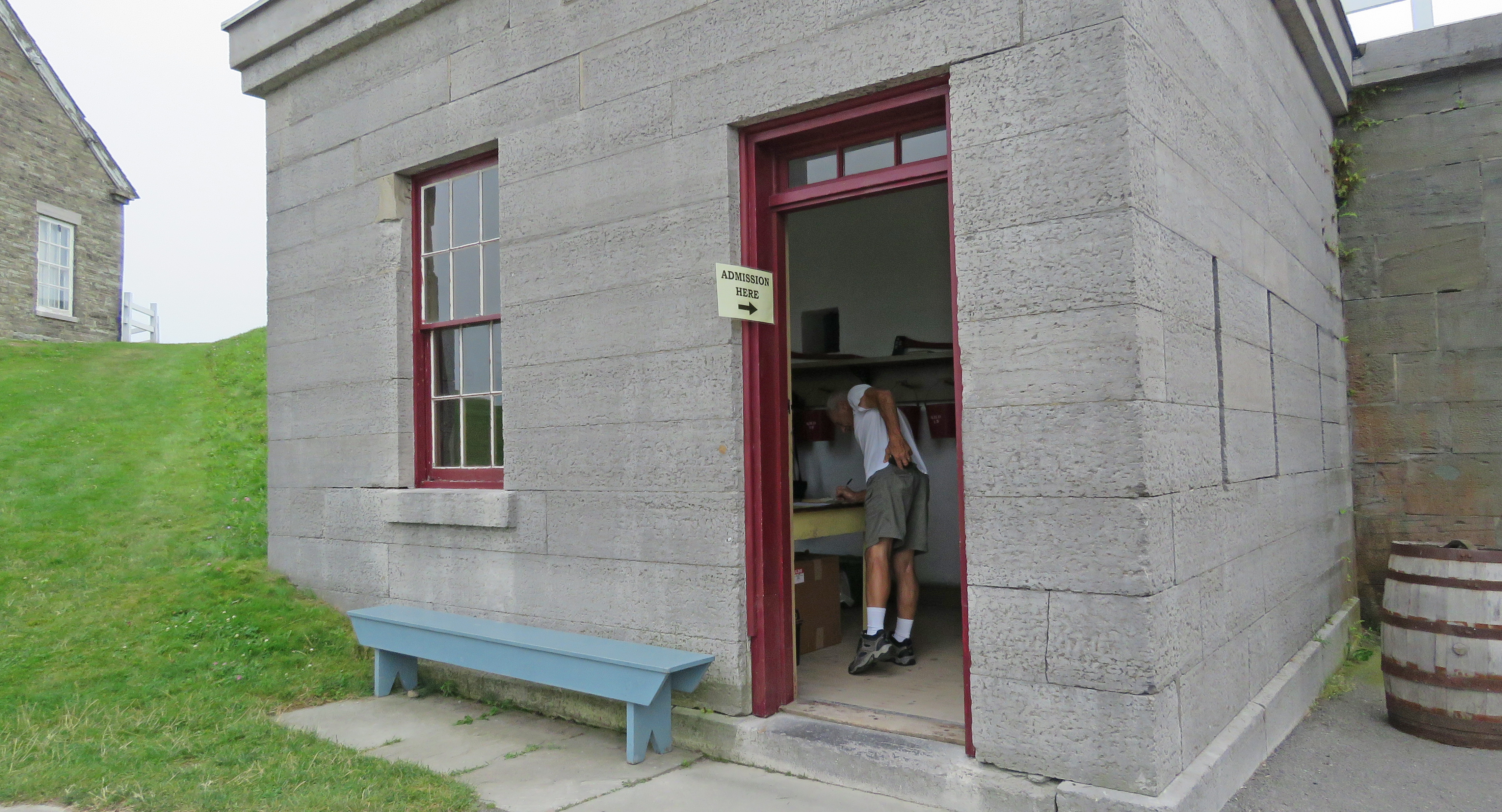
 This place has seen a lot of action! The British built a fort here in 1755 during the French and Indian War. The French destroyed that fort and the British rebuilt it in 1759. The British abandoned it and the Patriots destroyed it in 1778. The British rebuilt it in 1782 and it was turned over to the US in 1796 after the Revolutionary War. The British returned in 1814 during the War of 1812 and destroyed it again. 

The current fort was built in the years leading up to the Civil War using locally quarried stone. It wasn't attacked again but it was still a busy place. During WWI it was military hospital, then an infantry base and leading up to WWII, a National Guard base and a training base for military police. It housed Jewish refugees from August 1944 to February 1946. After the refuges became US citizens the buildings were occupied by World War II veterans and their families. It became a state historic site in 1949. 

 In 1940 many buildings were constructed outside the fort walls to house new recruits. Most of these buildings are now gone and the few that remain are owned by the City of Oswego. The historic site includes the stone and earth walls that surround the fort and the buildings located inside the walls- guardhouses, powder magazine, storehouse, enlisted men's barracks, Army office building, and officer's quarters constructed in the 1840s. Several of the building have exhibits or are furnished to reflect the way the fort would have looked in the 1860s. There's also a walking path that circles the city park and leads to the fort cemetery. 


The first floors of barracks and officers' quarters are accessible. Stairs are the only access to the second floors.The other buildings, including the admissions building, are not accessible. The top of the fort walls can be accessed with a strong helper to push up the grassy ramp. The path to the cemetery is accessible but was closed at the cemetery due to falling branches. 


     The parking lot is large enough for any RV.  Fort  43.46411, -76.50689


Friday, August 9, 2024

Memorial Art Gallery

This museum is a smaller version of the excellent Cleveland Museum of Art with artwork from around the world, ranging from antiquities to contemporary art. Definitely worth a visit.

The museum is accessible.

There are four parking lots. The lot on the right side of the entrance drive off of Goodman Street is the best one for RVs. Back up over the grass or pull through two spaces. Museum   43.15796, -77.5862