Showing posts with label LOUISIANA. Show all posts

Saturday, December 27, 2025

Earl G Williamson Park

This little parish campground is very inexpensive especially since it has water and electric hookups and a dump station. Other amenities include a fishing pier, restrooms with showers, a swimming area, and a playground. Most of the sites in the loop have shade shelters over the picnic tables. The sites along the water may not have shelters. They are also close together.  

The photo below is of the picnic area. I didn't get a photo of the waterfront RVs sites but they are next to the picnic area and lined up side by side so the view is from the front or back windows depending on whether you pull in or back in. 

None of the sites are designated as accessible but they have wide, paved parking pads so they are usable. The picnic tables do not have extended tops or paved access and they are on concrete slabs so they may not be accessible. Campground   32.72847, -93.97285


Thursday, December 25, 2025

Louisiana State Exhibit Museum

Many of us who travel to national forests and parks in the US are familiar with the work of the Civilian Conservation Corp but the depression era programs created by President Roosevelt were broad and far reaching. The Public Works Administration built  dams, bridges, courthouses, hospitals, university buildings, and schools, among other things.  Communities decided what they wanted and local architects, engineers, and construction workers were employed. Many of  these buildings are still in use today, a testament to the quality of the construction.

The museum is one of the PWA buildings. It has an unusual circular design with a courtyard and fountain in the center and exhibits in cases on both sides of an outer ring. Twenty wonderfully detailed panoramas of rural life in Louisiana in the 1930s and 40s were made by artists employed under another PWA program, the Federal Art Project. The figure are made of beeswax with bendable wire frames. The building and these panoramas make the museum a must see spot.

Other exhibits cover the natural and human history of Louisiana including a re-assembled Bour-Davis, the luxury model of a short lived local car manufacturer, and a thousand year old dugout canoe.

The museum is accessible. The accessible entrances are on either side of the building. We missed the four large fresco murals at the front entrance so make sure to go through the inner doors at the front entrance to view the murals in the vestibule. 
 
RVs will fit in the lot if backed up over the grass or parked lengthwise across the spaces.  Museum  32.48023, -93.78583


Thursday, December 26, 2024

Louisiana History Museum

The museum is in the basement of the 1907 Alexandria Public Library. Display cases hold collections of donated items that highlight various periods of central Louisiana history but there isn't a lot of  interpretive text. Due to being short staffed the volunteer who was manning the library closed it to give us a guided tour of the museum. This was another case of a very friendly and informed small city museum volunteer who was ready to explain and discuss any of the items on display. 

The accessible entrance is in the rear of the museum. The museum is accessible.

RVs will fit in the on street parking. Museum   31.30912, -92.44465


Monday, December 23, 2024

Alexandria Museum of Art

 Changing exhibits with a focus on Louisiana and southern artists fill the galleries of this small museum. There's also an arched room painted exactly like the one from the 12th century church of Vera Cruz de Maderuelo in Spain. 


The museum is accessible with an elevator to the second floor galleries.

RVs will fit in the free parking spaces on the 2nd Street side of the museum. Museum  31.31215, -92.44437


Thursday, February 1, 2024

Louisiana State Capitol

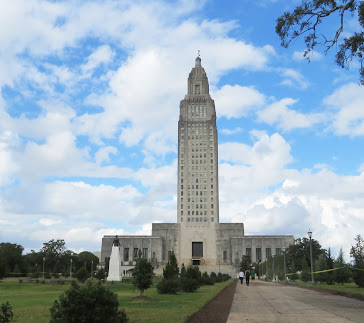
 The Louisiana State Capitol is the tallest state Capitol building in the US. Good views of the river and city can be seen from the observation deck on the 27th floor. The first floor and the basement are the main areas of interest to most visitors. The first floor has the Senate and House chambers plus beautiful murals and bronze plaques depicting important events in Louisiana's history. The basement has a few cases with crafts and artifacts.

The Louisiana State Capitol Building is the tallest Capitol building in the US. Good views of the river and city can be seen from an observation deck on the 27th floor. The first floor and basements are the main areas of interest to most visitors. The first floor has the House and Senate chambers plus beautiful murals and bronze plaques depicting important events in Louisiana's history. The basement has a few display cases of local crafts and artifacts. An large statue of Huey Long, who served as governor from from 1928 - 1932, stands on the Capitol grounds. Long was popular with rural and poor voters for his infrastructure projects that paved roads and built bridges.  He also improved health facilities, established night schools for adults, and supplied school children with free text books. He pushed against opposition for construction of the new Capitol building which was finished after his term as governor. In 1935 while serving as a state senator he was shot and killed by the son-in-law of a political opponent. 

 A large statue of Huey Long, who served as governor from 1928 - 1932, stands on the Capitol grounds. Long was popular with rural and poor voters for his infrastructure projects that paved roads and built bridges.  He also improved health facilities, established night schools for adults, and supplied school children with free text books. He pushed against opposition for construction of the new Capitol building which was finished after his term as governor. In 1935 while serving as a state senator he was shot and killed by the son-in-law of a political opponent.

Paths circle around in the Capitol Garden. Veterans Memorial Park to the east of the Capitol features the Old Arsenal Powder Magazine Museum (closed when we visited), an Indian mound, and paths along the water. 

I think there's an accessible entrance on either side of the long flight of steps at the Capitol building. We used the entrance on the left side.The basement and the first floor of the Capitol are accessible. Two elevators must be used to go to the 27th floor. The observation deck is not accessible due to a high threshold. The paths in the park are paved and accessible. The steep path to the top of the Indian mound is not accessible.

RVs can be parked on the streets south of the Capitol or in the lot parallel to Route 190 to the west of the Capitol. Capitol   30.45661, -91.18735


is the tallest Capitol building in the US. An observation deck on 27 floor circles the building for great views of the city and the river. There are not many exhibits but visitors are free to roam around. The first floor is the only floor of interest to most visitors but the basement does have a few exhibit cases. The second floor has the House and Senate Chambers and a large hall with beautiful murals and bronze plaques with details on important events in Louisiana's history.
 is the tallest Capitol building in the US.  27 floor where there's an observation deck that circles the building with great views of the city and the river. There are very few exhibits but visitors are free to roam around. The first floor and the basement are the only floor of interest to most visitors. The first floor has the House and Senate Chambers and a large hall with beautiful murals and bronze plaques with important events in Louisiana's history.

Monday, January 9, 2023

Louisiana Orphan Train Museum

In the mid 1800s a large number of children in eastern cities became orphans when their parents died during typhoid, yellow fever and flu epidemics. Others were abandoned due to poverty, illness, or addiction. With nowhere to go the children lived in the streets, forming gangs for protection and selling matches and newspapers to survive. Charities established to help the children developed programs to place the children in foster homes which were often in farming communities. The children traveled by train to their new homes hence the term "orphan train".

The children sent to Louisiana were babies, toddlers, and young children from the New York Foundling Hospital. Since this was a Catholic charity the children were placed in Catholic families even if that was not their birth family's religion. All of the placements were arranged beforehand with families who had been approved by the parish priests. Most of the placements were considered successful although there were cases of children running away. The woman who gave us a tour of the museum is the grandchild of one of the orphan train children. It was something that her grandmother rarely discussed leading the woman to believe that her grandmother's experience was not a happy one.

The museum has photographs and stories of many of the children. Some of the families kept the outfits that the children were wearing when they met their new families. These and other articles that the children brought with them are on display.

The museum is located in a former train depot which is part of Le Vieux Village, a collection of relocated historic buildings. It may be possible to see the interiors of the buildings by asking at the tourist information center which is also on the grounds. Since none of the buildings have ramps we did not ask  about visiting them but we did follow the paved walkways to read the interpretive signs at each building.
The Orphan Train Museum is accessible. The buildings in Le Vieux Village are not accessible due to steps and no ramps. The paths are paved and accessible.

The parking lot is small but RVs can be parked parallel to the museum building.  Museum  30.53177, -92.07508


Wednesday, January 4, 2023

Evangeline Downs Racetrack & Casino

Oversize parking is way in the back lot but there's an entrance close by that goes into the casino so it's not as inconvenient as it seems. Th lot is large but might get busy with horse trailers when a race is scheduled.

The carpet is plush which makes rolling tiring. The money and card slots are easy to reach. Casino  30.52808, -92.0603

Sunday, January 1, 2023

Hollywood Casino

A few years ago the Louisiana Senate approved a bill that allows casinos to move from their riverboat operations into land based casinos. When we visited the Hollywood Casino their land based casino wasn't ready to open so I can't report on the accessibility of the interior but the parking lot is good - large and fairly level. No need to sign in. Casino  30.46127, -91.19155
Wednesday, December 28, 2022

West Baton Rouge Museum

The museum consists of several small exhibit galleries featuring permanent and changing exhibits. The centerpiece is a 33-foot model of a sugar mill, originally constructed for the 1904 Louisiana Purchase Exposition in St. Louis. There's also a short film shown on request. Seven historic buildings, which can be seen by guided tour only, have been relocated to the grounds. Three of the buildings are cabins furnished to represent how rural Black people lived during times of slavery; reconstruction and Jim Crow; and the 1950s and 60s. The Aillet House is a typical Creole style sugar plantation house. An army surplus building has been repurposed to represent a juke joint. The Arbroth Store, closed in 1980 after operating for 100 years, is stocked with goods that would have been sold from the early to mid 1900s.
This museum has excellent wheelchair access. A ramped entrance can be accessed from the 6th Street parking lot. There's also a ramp at the main entrance that allows access to one gallery which otherwise could not be seen without navigating a few steps, The museum exhibit galleries are accessible. The walkways between the relocated buildings are all in very good condition. All of the buildings have ramps at the rear entrances.
The parking lots are only large enough for vans and short RVs. Large RVs can be parked on North Jefferson Ave.  Museum  30.4605, -91.20692