Thursday, November 9, 2023

Textile Heritage Museum and Glenco Village

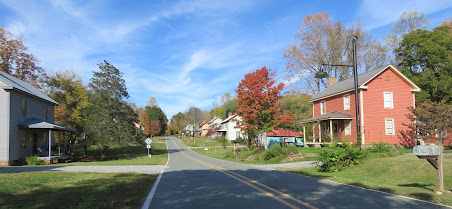
After the Civil War, as the south struggled to rebuild it's economy, James H. and William E. Holt, following their father's lead, built their first cotton mill along the Haw River in North Carolina. The location was relatively isolated so company housing was necessarily to attract workers. 48 houses, a company store, a church and a schoolhouse were built. The Glenco Mill complex included the mill, warehouses, dye house, powerhouse, offices, and utility buildings. It was a self contained community and operated like many company towns with low pay and tabs at the company store but the Holts were more generous than most owners. The houses, although drafty, were well built and roomy, rent was cheap, and mill supplied electric power to the houses. Young children were required to attend school rather than work in the mill.
Glenco Mill, which began operations in 1882 manufacturing high quality plaid flannel, was one of the last water powered mills in North Carolina. When it closed in 1954, many of the residents moved away but the village was never a true ghost town. The village, still isolated from the main traffic routes, was in remarkable condition when Preservation North Carolina purchased the property in 1997. The houses were put on the market after the streets were paved and new water, sewer, electric and gas connections were installed. New owners have to follow a set of design guidelines to ensure that any new construction or future renovation preserves the historic character of the village. 

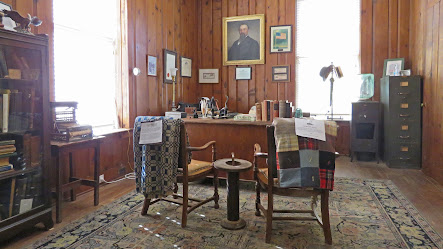
The village consists of 39 restored original houses, 7 historically accurate new houses, the company store and offices, and the mill buildings. Most of the buildings are privately owned and not opened to the public but the company store and the offices house the Textile Heritage Museum. One of the houses is furnished with period pieces and opened to tour.

The basement is the only accessible part of the museum. The accessible entrance is on the left side of the building and the door tends to stick so push hard. The ground floor of the museum has steps to the porch and steps at the entrance doors. The house has steps to the yard and to the porch. 

Parking is limited. There's a long accessible spot on the left side of the museum, close to the accessible entrance. Museum  36.13889, -79.42798


Tuesday, November 7, 2023

Guilford Courthouse National Military Park

 The Revolutionary War battle fought in the forest west of Guilford Courthouse could be considered a minor skirmish but it was part of a series of battles between the British and the Patriots that destroyed the British hold on the southern US and helped end the war. 

On March15,1781 British General Charles Cornwallis led his troop of 1,900 men north with the intention of  entering Virginia. Continental Army General Nathanael Green's much larger army of 4,500 men formed three battle lines across the road and the forests, blocking the route north. Half of Green's men were untrained local militia. Many in the first line broke and fled at the start of fighting, the second line was hindered by thick underbrush, and when the British converged on the open field of the last line, Green was forced to retreat. Even though the British won the battle Cornwallis lost 25% of his army while the losses to Green's army were light. Cornwallis surrendered at Yorktown,Virginia eight month later. 

The park has a small visitor center with exhibits featuring artifacts from the battlefield and a short film about the battle. A 2 1/4 mile loop road has stops with interpretive signs. A network of trails through  the woods in the center of the loop also lead to the signs. We attempted to follow the trails but got confused by the many intersections so I recommend walking the road instead of the trails.  
The visitor center is accessible. The road is lightly traveled so it's safe to roll along it. The trails are hard packed or paved but the terrain is hilly.

The parking lot has two long pull-in spaces for buses or RVs. Park  36.13069, -79.84634


Sunday, November 5, 2023

Tanger Family Bicentennial Garden and Bog Garden

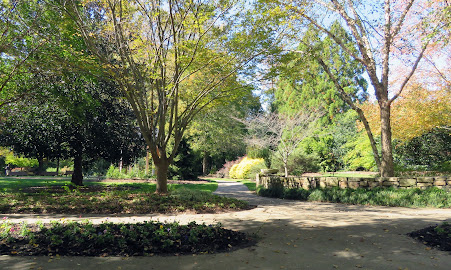
There are so many parks in Greensboro, North Carolina that it would take weeks to visit all of them. We didn't have time for that so we'll definitely have to stop here again. Tanger Family Bicentennial Garden and Bog Garden are just across the street from each other making it easy to see both in one trip. Neither are very large but nice enough that we circled around on the paths from different directions to extend our visit. 

 The paths in Tanger Garden are paved and accessible with cultivated gardens, statues, an old mill, and benches. 

The Bog Garden has a boardwalk and natural surface trails. The Nell Lewis Trail and the Creekside Trail are not accessible due to the terrain but the main loop is accessible. 

The crosswalk to go from the Tanger Garden to the Bog Garden has a push button to activate a flashing yellow light, The curb cuts are in good condition. 

The parking lots are large enough for RVs if backed up over the landscaping or parked lengthwise across the spaces. Tanger  Bog  36.09295, -79.84144


Friday, November 3, 2023

Natural Science Center of Greensboro

The Center is half  science center and half zoo. The science center has a fun area with tiny holographic paleontologists discussing dinosaurs. The sound isn't very good though and it's hard to understand what the paleontologists are saying. Overhead, a large screen features dinosaurs parading by the projected images of visitors. I had to quit playing with this when a group of kids came along. :D There's also a OmniSphere Theater. 

 
The zoo has touch tanks, several large aquariums with the cleanest water and glass that we've ever seen, reptiles, and an outside area with a small selection of animals. The animals are all well cared for with roomy enclosures and plenty of vegetation. 

The science center and theater are accessible. Many of the animals are difficult to see due to the design of the railings. 

The parking lot is large enough for RVs but it's an uphill push if you don't get a space in the first row. Center  36.12968, -79.83348


Wednesday, November 1, 2023

Greensboro History Museum

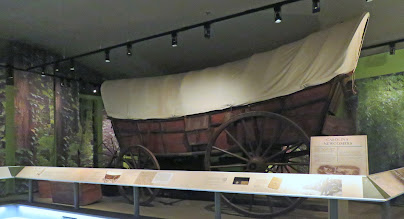
The history of Greensboro is covered with exhibits on Native Americans, settlers from Pennsylvania, the growth of the city as a manufacturing base, and the fight for civil rights. Several exhibits feature furnished rooms from mansions that have been torn down. A small park adjacent to the museum has four historic buildings built in the 1700s. The buildings are open for guided tours on request. 

The museum is accessible. The carpeting in the area with the furnished rooms is very plush which makes pushing hard. The historic buildings are not but there's a paved pathway through the park. 

 The parking lot is large enough for small RVs. There are a few spaces north on Summit Street where larger RVs will fit. Museum  36.07547, -79.78734