Saturday, September 4, 2021

Dickinson Museum Center

  The four exhibit areas of the museum are vastly different but all are connected to the history of Dickinson, North Dakota. The first floor of the main building has dinosaur fossils, mainly collected from the 4-state region of Montana, Wyoming and the Dakotas, and a great collection of minerals, precious stones, and shells. The lower floor contains historic artifacts arranged in room settings with each room representing a different decade.

  The Pioneer Machinery Hall houses agricultural exhibits and equipment.

  The Prairie Outpost Park is a collection of historic buildings and buildings built to represent the various ethic groups that settled in the area. A display of fossilized wood and an oil pump jack are also located on the grounds.


The main museum is accessible. The museum was short staffed the day that we visited and we did not go into the machinery building or the historic village buildings. The machinery building looked accessible. Most of the village buildings looked accessible, The sidewalk and paved pathway to the village are steep. Most wheelchair users will need assistance.

  The parking lot is large enough for any RV.  Museum    46.8947, -102.78422

Thursday, September 2, 2021

Dickinson Reservoir - Patterson Lake

  Twenty two RV sites are lined up side by side close together. There are trees and bushes between them so there’s some degree of privacy but voices carry from site to site. The sites have water, electricity, tables, and fire rings. Other amenities include a dump station and a bathroom with flush toilets and showers.

  The campground also has a primitive section for tent campers only. It has some unusual rules. The people in the tent area are not allowed to use the dump station or the showers. They are permitted  to stay for only three days out of 30.

   Anyone 62 or older gets half off of the camping fee.

   The park is fairly large with a sandy beach, a volley ball court, playgrounds with exercise areas for adults, and a 1.9 mile paved walking trail.

   The campground and trail are accessible. Campground  46.86674, -102.85309

Tuesday, August 31, 2021

Chateau De Mores State Historic Site

  Antoine de Vallombrosa, the French Marquis de Mores came to the Dakota Territory in 1883 with a plan to make a fortune in the cattle industry. He bought 44,000 acres of range land, built a slaughter house, and established a town with homes for employees, offices, a hotel, a general store, a brick plant, a school, a Catholic church, and a recreation hall. He thought he’d hit on a brilliant idea – to slaughter the cattle on site and pack the meat on ice in rail cars to be shipped to eastern markets rather than shipping them live by rail to the Chicago packinghouses.
  The plan failed for many reasons - fierce competition from major Chicago-based packers, the devastating effects of drought and deep snow in 1886, and the Marquis’s inexperience in business.

 The large summer house that the Marquis de Mores, built high on a hill overlooking the Little Missouri River valley and the town of Medora was called a chateau by the townspeople even though it more closely resembles a barracks. The Mores family enjoyed inviting their family and friends to the untamed west for hunting trips and to experience rough living in a  rustic setting. 

  The family used the house for three summers from 1883 to 1886. After his cattle business failed the Marquis returned to France where he became  embroiled in political controversies and was murdered in 1889. The family visited the house once after the Marquis death.

  In 1921 the eldest son gave the caretaker permission to run a boardinghouse in the chateau so even though it suffered from lack of upkeep the chateau survived while much of the town did not. The chateau was turned over to the state of North Dakota in 1936 on the condition that it be maintained and opened to the public. It was restored from 1937 to 1941 by the Civilian Conservation Corps.


 The site includes an interpretive center with exhibits on the Mores family and the Marquis’s cattle business. Exhibits about the Civilian Conservation Corps and Work Projects Administration fill a separate gallery. The chateau is opened for self tours with guides available to answer questions.

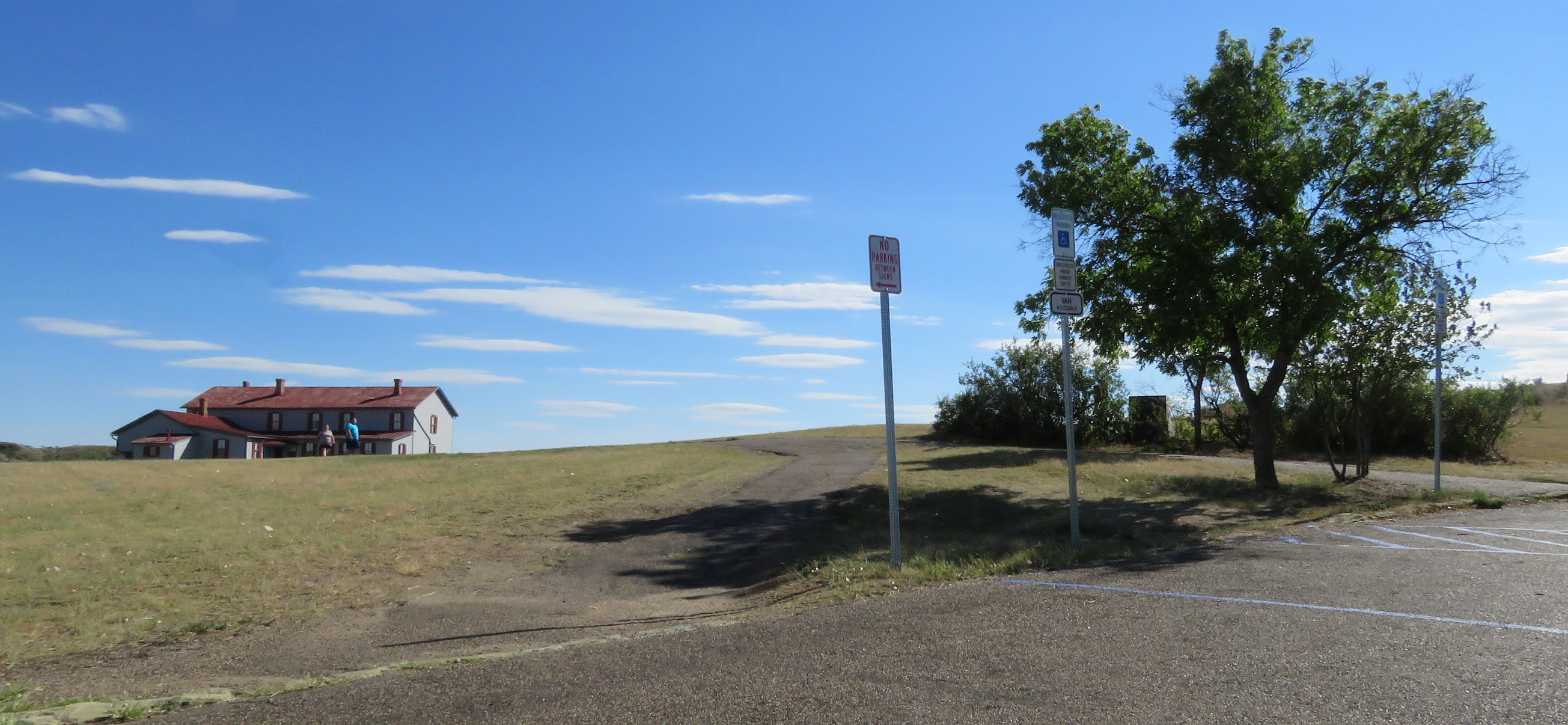
  The interpretive center is accessible. The chateau has several difficult areas. The path from the parking lot is very steep and uneven. The thresholds at the chateau entry and exit doors, and between the rooms are very high.
 
   The interpretive center and chateau parking lots are large enough for RVs. Chateau  46.91523, -103.53393

Sunday, August 29, 2021

Fallon Bridge Fishing Access Site

   Fallon Bridge is less of the campground than the other fishing access sites where we recently camped. There aren’t tables, fire rings, or a vault toilet but it has a good boat ramp to the Yellowstone River which I imagine makes it a favorite spot for boaters.
  The camping area is large and flat. Close proximity to both the frontage road and the interstate means it’s a bit noisy but the river view is nice. Camp  46.85668, -105.11497

Friday, August 27, 2021

Waterworks Art Museum

The museum is housed in a 1910 waterworks building. For over 60 years drinking water for Miles City was filtered and stored in the building which now serves as an interesting small museum featuring exhibits from the museum’s permanent collection and traveling exhibits.
The museum, located on the lower level of the building, is accessible. The upper level is not open to the public,

  The parking area is large enough for RVs. Museum  46.40573, -105.86866

Far West Fishing Access Site

  We stayed here in 2015 but I think we were in the day use area, not the campground. It didn’t matter because we didn’t see anyone the entire time we were there but this time we decided to stay in the campground loop. There are about seven sites around the loop and although there are a lot of trees the access to them is blocked by posts so it’s not possible to take advantage of the shade they provide.
  None of the sites are accessible and getting to the tables may be difficult due to the downhill slope from the loop road.

  The sites are big enough for most RVs. Campground  46.28043, -106.47512

Wednesday, August 25, 2021

Selkirk Fishing Access

  Montana has a lot of fishing access sites but finding the ones that permit camping and are free takes a bit of research. This handy map has links to the access sites but the title is misleading because not all of them have camping listed as an activity.
Selkirk has three camp areas - large mowed area in the center of the loop road, a grassy meadow area, and a gravel parking strip tucked into the brush. The two large areas are suitable for small groups. A short path behind our motorhome in the top photo leads to a shallow stream named the Musselshell River. :-D

  The mowed area is fairly accessible because the ground is hard packed. High grass in the other two campsites makes rolling around difficult. The path to the stream is not accessible.

  Any size RV will fit in the camp area. Camp  46.46732, -110.22904

Tuesday, August 24, 2021

Charles M Bair Family Museum

   In 1898 Charles M. Bair left his wife, Mary, and their two young daughters in Montana while he traveled to the Yukon to sell his permafrost thawing invention to the gold miners. He may not have made much money from the invention but buying and selling gold claims made him wealthy enough to purchase a large ranch in Martinsdale, Montana. Investments in oil, mining, banking and real estate added to the family’s wealth and allowed Mary Bair and her daughters Marguerite and Alberta to amass a large collection of western paintings, Native American artwork, and antiques.

 The two daughters lived in the house after their parents died and added to the collections, even remodeling the house with additional rooms to hold everything. Neither woman had children so they decided to leave the house and all of their collections to the state of Montana. Alberta, the last of the family, died in 1993 and the house was opened as the Bair Family Museum in 1996. The property is still a working sheep and cattle ranch. The family legacy includes a trust fund that pays for upkeep on the property, scholarships for local students, and grants to charities.
Gold plated bathroom fixtures
1950s kitchen
  The site has a visitor center with a small museum housing some of the artwork, the stables with exhibits and a gift shop, and the house itself which is shown by tour only.
  The museum, stables, and house are accessible. The second floor of the house is closed to visitors.

  The parking lot is large enough for RVs. Museum  46.46546, -110.31807