Saturday, October 6, 2018

National Museum of American Jewish History

IMG_4723
  The first Jewish community in the US was founded in 1645 when twenty-three emigrants from Recife, Brazil landed in New Amsterdam (now NYC). Jews had been living in Recife for almost 150 years, secretly practicing their religion while the city was under Portuguese control, and more openly under Dutch rule. The Portuguese gained back control of Brazil 1654 and 16 ships of Jewish and Dutch colonists fled to Holland and the Dutch, French, and English colonies in the Caribbean. One ship was captured by Spanish pirates but rescued by a French privateer who agree to take the Jews to New Amsterdam for a payment of 2,500 guilders ($1,400 in current US dollars).
IMG_4741
    Jewish immigration to the US was slow with only 1,000–2,000 Jewish residents in 1790. Most settled in cities and dealt in trade or manufacturing, and operated dry goods but the population was so small and scattered that few synagogues were built before the mid 1800s. Anti-Jewish uprising in Russia and central Europe in the late 1800s and early 1900s brought a rush of Jewish immigrants along with immigrants fleeing from poverty in Ireland and eastern Europe. The foreign languages and customs of so many new immigrants unsettled the US citizens to such an extent that strict quotas were enacted - with horrible consequences for all of the Jews who sought to escape from Nazi persecution in the 1930s and 40s.
IMG_4749IMG_4751                    IMG_4750
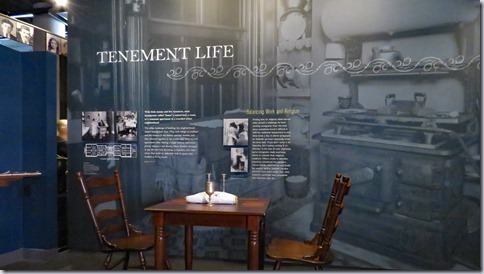
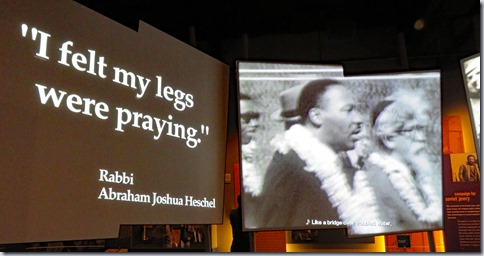
    The museum follows the timeline of Jewish settlement in the US from 1645 up to the present. Each of the three floors covers a distinct period of history with exhibits, audio/video displays, and artifacts. 
          IMG_4832IMG_4834
  The museum is accessible but the entry doors are heavy and do not have push buttons.The security guard was quick to offer help.

    We parked along Dock Street which is about 1/2 - 3/4 of a mile from the historic district where all of the museums and landmarks are located. Dock Street is much wider than most of the other streets and we could always find an open parking space. The spaces are not marked so a ticket from the kiosk – payable by cash, credit card or phone app - is good for any size vehicle. Parking is limited to 3 hours however we were informed by a friendly local man that a disabled placard would get us an extra hour for free. This was confirmed later by a parking officer. Almost all of the sidewalks and curb cuts are in good condition and the terrain is fairly level. Museum  39.9504, -75.14851
pennsylvania2

Friday, October 5, 2018

Philadelphia's Magic Gardens

IMG_4794

  Isaiah and Julia Zagar opened a folk art store Philadelphia in 1968 and, as way of attracting attention to it, Isaiah covered the front wall with a mosaic of mirrors and broken pieces of glazed tile and pottery. The next building that they bought in 1991 was adjacent to two abandoned lots which Isaiah cleaned up and fenced off. After covering the building walls with mosaics, he started creating a mosaic garden. Eleven years later the absentee owner of the land discovered the artwork and threatened to sell the property. Fortunately, with community support, the artwork was saved. The site now includes tunnels and grottos, all covered with colorful mosaics. There’s a fee to go inside the gate but you can see a lot from outside. The mosaics extend around the two sides of the building that face Alder and Kater Streets. There are dozens of murals on other buildings in the area – Map. We didn’t know about the map so we missed most of them.

IMG_4800IMG_4801          IMG_4802IMG_4795

  The Magic Gardens have narrow passageways and many steps so they are not accessible but it’s possible to see a lot of artwork from the streets.

  The streets are narrow and parking is hard to find. A parking garage across the street has a 6’6” height limit. We parked along Dock Street which is about a mile east. Dock Street is much wider than most of the other streets and we could always find an open parking space. The spaces are not marked so a ticket from the kiosk – payable by cash, credit card or phone app - is good for any size vehicle. Parking is limited to 3 hours however we were informed by a friendly local man that a disabled placard would get us an extra hour for free. This was confirmed later by a parking officer. The terrain is fairly level but some of the sidewalks and curb cuts are in bad condition.  Gardens  39.94283, -75.15941

pennsylvania2

Thursday, October 4, 2018

Independence National Historical Park Visitor Center, Independence Hall & the Liberty Bell

IMG_4633

   Go to the visitor center to pick up maps and brochures, watch a short video, and enjoy a handful of exhibits but the real reason for stopping is to get tickets to Independence Hall. Completed in 1753 as the Pennsylvania State House, this is the building where both the United States Declaration of Independence and the United States Constitution were debated and finalized. Tickets for timed guided tours are free. Arrive a little early for security screening.

IMG_4636         IMG_4635

  Independence Hall is accessible. Both of the double doors may need to be opened for wheelchair access. The website indicates that the second floor, which is not accessible, is part of the tour. This was not offered when we visited. The property is surrounded by fencing and the accessible exit is not marked. We wandered from one exit to another before a guard let us out the entrance gate.

  IMG_4726IMG_4731

  The building housing the Liberty Bell is located on the long grassy mall between the visitor center and Independence Hall. Everyone must go through security screening so there may be a long line. We visited in late afternoon and did not have to wait. There are exhibits and a short video about the bell. The building is accessible.

IMG_4689IMG_4685

   This was also the location of the the executive mansion where President Washington stayed from November 1790 to March 1797 and President Madison from March 1797 to June 1800. The mansion was demolished in 1832 but the walls have been partially reconstructed. Exhibits and videos explore the lives of the presidents, their families, and the slaves who lived in the mansion and the contradiction between forming a free nation but keeping  part of the population in slavery. The exhibits are accessible. 

    We parked along Dock Street which is about 1/2 - 3/4 of a mile from the historic district where all of the museums and landmarks are located. Dock Street is much wider than most of the other streets and we could always find an open parking space. The spaces are not marked so a ticket from the kiosk – payable by cash, credit card or phone app - is good for any size vehicle. Parking is limited to 3 hours however we were informed by a friendly local man that a disabled placard would get us an extra hour for free. This was confirmed later by a parking officer. Almost all of the sidewalks and curb cuts are in good condition and the terrain is fairly level.  Independence Park  39.9521, -75.14957

pennsylvania2

Wednesday, October 3, 2018

Museum of the American Revolution

IMG_4699

   Interesting exhibits, historical artifacts (including Washington’s campaign tent) and audio visual displays make this museum a good place to learn about the events leading up to the 1776 Declaration of Independence and the Revolutionary War. Important battles plus the lives and opinions of ordinary people, through the years of war and on both sides of the conflict, are all covered very well.

IMG_4698IMG_4704IMG_4702IMG_4707IMG_4712

  The museum is accessible. A few displays have slide out panels that are hard to manipulate.

   We parked along Dock Street which is about 1/2 - 3/4 of a mile from the historic district where all of the museums and landmarks are located. Dock Street is much wider than most of the other streets and we could always find an open parking space. The spaces are not marked so a ticket from the kiosk – payable by cash, credit card or phone app - is good for any size vehicle. Parking is limited to 3 hours however we were informed by a friendly local man that a disabled placard would get us an extra hour for free. This was confirmed later by a parking officer. Almost all of the sidewalks and curb cuts are in good condition and the terrain is fairly level.  Museum  39.94853, -75.14596

pennsylvania2

Tuesday, October 2, 2018

Portrait Gallery in the Second Bank of the US

IMG_4632

  The Second National Bank was chartered in 1816 to handle all fiscal transactions for the U.S. Government. It was a private corporation with public duties. 20% of the capital was owned by the government and the other 80% by private investors. The bank’s charter lasted for 20 years. Andrew Jackson, who was president from 1829 – 1837, ran on an anti national bank platform and refused to renew the charter. The bank’s holdings were then transferred to state banks.

  The building, modeled after the Parthenon, is now part of Independence National Historical Park and houses a large collection of portraits of notable people from the 1700s and 1800s. The portraits are beautiful but all in all the museum is pretty dull. It’s free so it’s still worth a quick visit.

IMG_4627IMG_4628

  The accessible entrance is on the west side of the building and goes to the basement level which has been renovated and has a few exhibits. The door is automatic with a pushbutton but it may stick and be hard to open. An elevator accesses the first floor where the portrait gallery is located.

IMG_4629

   We parked along Dock Street which is about 1/2 - 3/4 of a mile from the historic district where all of the museums and landmarks are located. Dock Street is much wider than most of the other streets and we always found an open parking space. The spaces are not marked so a ticket from the kiosk – payable by cash, credit card or phone app - is good for any size vehicle. Parking is limited to 3 hours however we were informed by a friendly local man that a disabled placard would get us an extra hour for free. This was confirmed later by a parking officer. Almost all of the sidewalks and curb cuts are in good condition and the terrain is fairly level. Gallery  39.94885, -75.14836

pennsylvania2

Monday, October 1, 2018

National Constitution Center

IMG_4637

  The Second Continental Congress agreed upon the Articles of Confederation shortly after the 13 colonies declared their independence from England in 1776. The articles served well during the Revolutionary War for conducting business in the US and with foreign countries but they gave little power to the federal government over the states. By 1887, four years after the end of the war, it became apparent that the newly formed country needed a stronger federal government to hold the states together. The Congress debated for almost six years before agreeing on the seven articles of the Constitution. The original drafts mainly dealt with the formation an effective federal government so including the Bill of Rights, 10 amendments that cover personal freedoms, was a hard fought battle. As the country progressed and changed 17 additional amendments joined the original 10.

  The museum timeline explores the need for a Constitution, how decisions are made based on interpretations of the Constitution, and the reasons for each new amendment. Other exhibits include become a citizen, voting, and the workings of the Supreme Court.

IMG_4673IMG_4678

   The museum is accessible.

   We parked along Dock Street which is about 1/2 - 3/4 of a mile from the historic district where all of the museums and landmarks are located. Dock Street is much wider than most of the other streets and we could always find an open parking space. The spaces are not marked so a ticket from the kiosk – payable by cash, credit card or phone app - is good for any size vehicle. Parking is limited to 3 hours however we were informed by a friendly local man that a disabled placard would get us an extra hour for free. This was confirmed later by a parking officer. Almost all of the sidewalks and curb cuts are in good condition and the terrain is fairly level. Museum  39.9529, -75.14929

pennsylvania2

Saturday, September 29, 2018

Independence Seaport Museum

IMG_4653

  The museum focuses on Philadelphia history as it pertains to the formation of the US Navy, ship building and shipyards on the riverfront, and the lives of African Americans from the arrival of the first slave ship at Penn’s Landing in 1684 to segregated shipyards in the 1940s. Other exhibits include a large room filled with many types of small boats, posters describing accidents involving ships on the Delaware River, and a changing exhibits gallery which, when we visited, featured Crazy Eddie, a local tattoo artist. Everything is nicely done. The Cruiser Olympia and Submarine Becuna are located outside and are open to tour.

IMG_4646IMG_4655IMG_4659

   The museum is accessible. The cruiser and submarine are not.

   There’s a parking lot and a garage on Walnut Street next to the museum. Neither are good for RVs but we found great on-street parking along Dock Street on the opposite side of Christopher Columbus Blvd. The spaces are not marked so a ticket from the kiosk – payable by cash, credit card or phone app - is good for any size vehicle. Parking is limited to 3 hours however we were informed by a friendly local man that a disabled placard would get us an extra hour for free. This was confirmed later by a parking officer. The sidewalks and curb cuts are in good condition. Museum  39.94611, -75.13992

pennsylvania2

Wednesday, September 26, 2018

Valley Forge National Historical Park

          IMG_4570

   In the third year of the Revolutionary War General George Washington chose the easily defended ridge above the small mill village of Valley Forge as the 1777-1778 winter camp for the main body of the Continental Army. Just months before the Continental Army had defeated the British in the Battle of Saratoga, (which is considered a turning point of the war) however, Philadelphia, the patriot capital, was under British control. Valley Forge, 18 miles northwest of Philadelphia, was chosen to maintain pressure on the British and to protect the rest of Pennsylvania.

IMG_4573

  The camp included 12,000 soldiers and 400 women and children who built 1,500 log huts and two miles of fortifications. It was the fourth largest city in the United States. So many people gathered in one area put a strain on the land and required large amounts of provisions. At times food and clothing were in scarce supply. No battles were fought at Valley Forge but nearly 2,000 people died from influenza, typhoid, and other diseases.

IMG_4576

   A strong advantage of the large encampment of soldiers was the opportunity for strict military training under the guidance of former Prussian officer Baron von Steuben. His reforms in supply systems, fighting tactics, military hygiene, and army organization formed the basis of the modern US Army and prepared the soldiers for five more years of war.

IMG_4611

  The park covers 3,500 acres and has a visitor center, a 10 mile auto tour, ranger tours, trolley tours (in season), a memorial chapel, a partially reconstructed redoubt, Washington’s headquarters, several monuments, and a 5.3 mile paved loop trail.

IMG_4582          IMG_4600          IMG_4593IMG_4612IMG_4617IMG_4619

   The visitor center is accessible but if your vehicle does not fit in the accessible parking spaces you must park in the large lot which is located down a hill. A fairly long and steep paved path goes to the visitor center. A crushed stone path leads to the huts at Muhlenberg’s Brigade and the reconstructed redoubt. The thresholds of some of the huts are high.The ramp for the chapel is on the west side of the building. A very long ADA compliant ramp goes to Washington's headquarters which is not accessible but there isn’t much to see anyway. Visitors may be dropped off to avoid the ramp. The detached kitchen, the path around the property, and the train station which has exhibits are accessible. Monuments and other sites have paved trails or can be viewed from your vehicle. The paved loop trail is accessible but hilly.

IMG_4602IMG_4588IMG_4585

  The parking lots at the visitor center, Muhlenberg’s Brigade, the chapel, Washington's headquarters, and most of the other sites are large enough for RVs. Line Drive, a one way road is narrow, curvy, and steep but can be driven with an RV.  Park  40.10187, -75.42521

pennsylvania2