Monday, September 24, 2018

Hopewell Furnace National Historic Site

IMG_4569

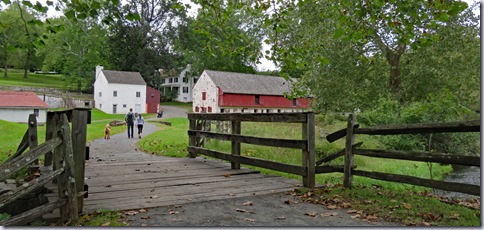
   Iron ore, limestone, and lumber to make charcoal are the essential ingredients for manufacturing pig iron. In the 1700s small iron furnaces sprung up anywhere these three were readily available. Since they were often far from towns each furnace location was a settlement in itself with an iron master's house, tenant houses, boarding house, school house, church, and company store. While Hopewell is not the earliest, largest, or most successful furnace in the eastern US it is one of the most complete and well preserved. It was in operation from 1771-1883 and played an important role in suppling canons and shot to the Continental Army and Navy during the Revolutionary War. Another interesting fact was uncovered in historic documents – both women and free blacks worked in the foundry and were paid the same wages as white men- highly unusual!

IMG_4543

   The visitor center has a short video and exhibits about iron making and the people who worked and lived in the village. Tours of the village, which has 12 stops with interpretive signs, are self guided. Living history programs and demonstrations are presented when staffing is available. During September and October visitors may pick apples in the orchard. Long apple picking poles are free to use but there’s a charge for the apples – $1.00 a pound. The money goes directly to the park rather than the national park funding pool.

IMG_4520IMG_4554IMG_4541IMG_4544         IMG_4532    IMG_4525 copy 2IMG_4526

The visitor center is accessible. The village is not wheelchair accessible but a ranger guided tour is available for visitors who can board a golf cart. The historic road goes steeply downhill to the village and is surfaced with large, loose stone. Most of the buildings have steps at the entrances. The iron master’s house which is sometimes opened to tour has a long flight of steps up to the porch and front door.

        IMG_4564

  RVs will fit in the lot if backed up over the grass or parked lengthwise across the spaces.  Furnace   40.20711, -75.77332

pennsylvania2

Sunday, September 23, 2018

Schwenkfelder Library & Heritage Center

IMG_4513

  Pennsylvania was founded in 1682 by William Penn, a Quaker, as a haven of religious freedom and tolerance. Quakers, Huguenots, Puritans, Catholics, and Calvinists all settled in southeastern Pennsylvania. The area was also a landing point for groups of Amish and Mennonites from Germany. The large German population was probably an attraction for the Schwenkfelders, a small Protestant sect that followed the religious doctrine of Caspar Schwenckfeld von Ossig.  From 1731 to 1737 most of the Schwenkfelders, 209 in all, sailed to America to escape persecution in their native Germany.  They’re still a very small group today with fewer than 2,500 members.

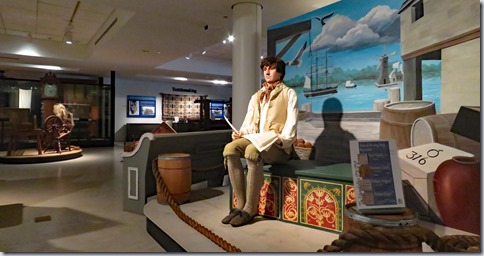
   The small museum has good exhibits with artifacts and historical information about Schwenkfelders.  Watch the short video for a quick history of the sect. Changing exhibits feature textiles and other items from the museums collections. Don’t miss the family tree carved by Amos Borneman in 1878.

     IMG_4518IMG_4519          IMG_4517IMG_4516IMG_4514

   The museum is accessible.

   The parking lot is large enough for any RV.  Museum  40.40062, -75.5061

pennsylvania2

Saturday, September 22, 2018

Allentown Art Museum

IMG_4492

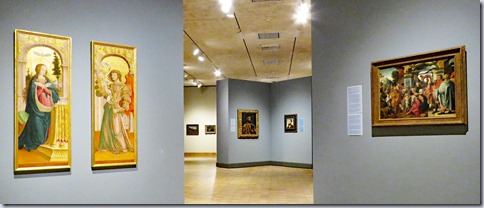
  In 1960 Samuel H. Kress, the founder of the S. H. Kress & Co. five and ten cent store chain, donated 53 Renaissance and Baroque paintings and sculptures to the museum from his large collection. Subsequently other donors gave generous gifts of textiles and works on paper. The addition of contemporary and regional art  gives the museum a diverse and slightly eclectic collection of artwork. The delicate and precise craftmanship employed to create katagami, stencils carved from mulberry bark and used for printing repeating designs on cloth, and molas, colorful inserts for blouses made by indigenous Panamanian women by layering  cloth and reverse-appliquéing, are especially intriguing. 

                           IMG_4497IMG_4504   IMG_4493IMG_4494IMG_4501IMG_4489         IMG_4503

   A small park with sculptures and a large mural is located on the opposite side of 5th Street.

IMG_4509

  The museum is accessible but getting to the entrance from the parking lot involves a uphill push along the sidewalk of 5th Street.

   Five spaces in the parking lot are reserved for museum visitors. There are also two accessible spaces. All are suitable for cars or vans only. RVs can be parked on Linden Street but turn your mirrors in as the street is narrow. Museum  40.60464, -75.46807

pennsylvania2

Friday, September 21, 2018

Lehigh Valley Heritage Museum

IMG_4482

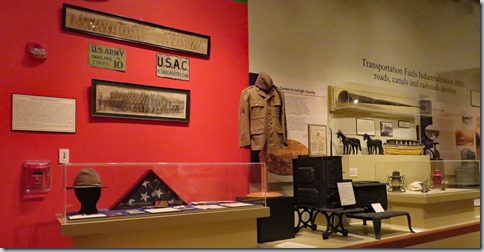
  Major highlights of the valley’s history from Native American settlements, to the Revolutionary War, European immigration at the turn of the century and WWII are all touched on in this small museum. It gives a good allover look at the human history of the area but nothing is covered in depth. Also on the grounds is the 1770 summer house of James Allen, the son of Allentown's founder. James Allen, who was loyal to the British during the Revolutionary War, used the house as an escape from Patriot activity in Philadelphia. The house is furnished with period pieces and is open for tours on weekends in the summer.

        IMG_4483IMG_4486           IMG_4488

  The museum is accessible. I believe the first floor of the house is accessible but we did not visit it.

  Parking is limited. DO NOT attempt to park in the lot located at the rear of the museum if you have a large vehicle. The street is very narrow and the lot is really small. Visitors with mobility issues should call ahead and get permission to park in the drop-off area in front of the museum. The parking spaces on the street are okay for cars but RVs may be too wide to fit due to the narrowness of the street.  Museum  40.60218, -75.46561

pennsylvania2

Thursday, September 20, 2018

America On Wheels Museum

IMG_4463

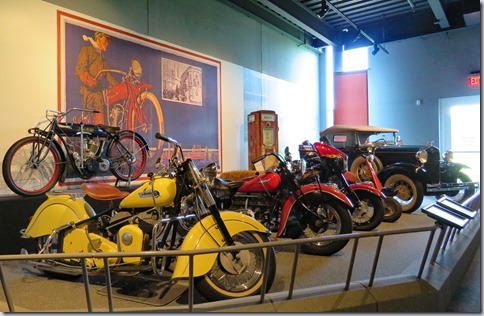
  Everything with wheels is on display in this small, nicely done museum- even restored pedal cars made for rich kids. Many of the cars and other vehicles have a connection to the area. A full-sized diorama features the complete service garage of local gas station owner. Another gallery explains the process of restoring an antique car from a barn find to a finely finished showpiece. The changing exhibit gallery has new exhibits every six months. The café, which is opened for business on weekends only, is a fully restored 1950’s soda fountain.

       IMG_4473  IMG_4466IMG_4472IMG_4471IMG_4470IMG_4475IMG_4476         IMG_4477

  The museum is accessible.

  The parking lot is large enough for any RV.

pennsylvania2

Wednesday, September 19, 2018

Mack Trucks Historical Museum

IMG_4448

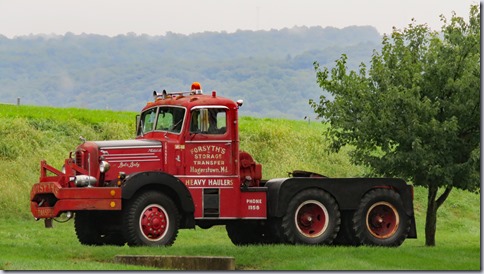
  The Mack brother’s first company manufactured large carriages and wagons so when they decided to build motorized vehicles they focused on passenger buses and heavy duty trucks. The AC model truck, which was introduced in 1916, proved to be invaluable to both the US and England during WWI. The British soldiers compared the reliability and durability of the truck to the tenacity of a bulldog, the symbol of Great Britain. The bulldog symbol was adopted by the company in 1921 and the first hood ornament appeared in 1932.

        IMG_4453

   Today Mack builds trucks for semi hauling, construction, refuse and the military. The cab and vehicle assembly plant is in  Macungie, Pa. and heavy-duty diesel engines, transmissions, and drivelines are manufactured in Hagerstown, Md. The  Engineering Development and Test Center has been moved to Greensboro, NC freeing up the building for a corporate showroom of new products and the museum.

IMG_4461

  The museum, which is fairly small, consists of a exhibit room with Mack trucks of different eras and uses; a testing room where the trucks were subjected to very cold and hot temperatures, run for hours on a treadmill, and subjected to high winds; and a super insulated quiet room used to check for stray noises. The museum is opened on Monday, Wednesday, and Friday. Guided tours are given on the hour and half-hour. Visitors are requested to wait for a guide but after the tour it’s okay to wander around on your own.

IMG_4457IMG_4456         IMG_4452

  The museum is accessible.

  RVs will fit n the lot if parked through two spaces or lengthwise across the spaces.  Museum  40.57258, -75.4938

pennsylvania2

Tuesday, September 18, 2018

National Museum of Industrial History

IMG_4394

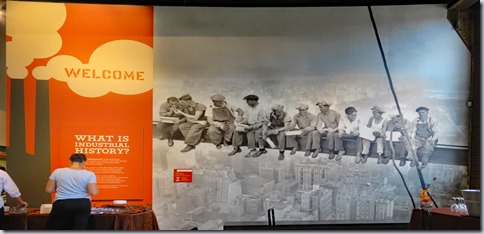
   Many of the large pieces of machinery in the museum are from the 1876 Centennial International Exposition which showcased state of the art technology for the time. The biggest piece is a Corliss Steam Engine that powered everything in the Centennial’s Machinery Hall. Other galleries include models of the Bethlehem Steel plant, exhibits about the Lehigh Valley Silk Mills, and information on a method for distilling propane discovered by Walter O. Snelling, a chemist from Allentown. There isn’t a lot about the history of Bethlehem Steel or the steelworkers themselves.

IMG_4390IMG_4385

  The museum is accessible.

  The parking lot on the opposite side of 2nd Street is large enough for any RV.  Museum  40.61286, -75.37021

pennsylvania2